
Golden Homes Blog
Foreign ownership of property in South Africa explained
Ask Golden Homes

You signed the lease on a flat in Cape Town three years ago. Now you want to buy. A South African colleague says it is straightforward. Your lawyer back home says it is complicated. The bank asks about exchange controls and your immigration status, and you realise you are missing a layer of the process nobody thought to explain. The phrase "foreign property ownership" keeps appearing, but what it covers, the rules, the restrictions, the paperwork, is less clear than the property itself.
What is foreign property ownership?
Foreign property ownership refers to the right of a non-South African citizen or non-resident to buy, hold, and sell property in South Africa. The country doesn't restrict who can buy residential property: there is no citizenship requirement, no minimum residency period, and no blanket prohibition on foreigners holding title to land. What the law does require is that money crossing the South African border follows the exchange control framework managed by the South African Reserve Bank (SARB), and that foreign owners meet their local tax obligations. The legal title registers in the buyer's name at the Deeds Office, the same as any local buyer.
Key Takeaways
- Foreigners can buy residential property in South Africa regardless of citizenship. Anyone living in South Africa must be here legally.
- Your purchase funds must enter South Africa through a registered South African bank and be declared to comply with SARB exchange controls.
- A non-resident who sells can send the proceeds home through their bank, provided the funds that came in were documented and the title deed is endorsed "non-resident".
- You will pay transfer duty on the purchase, and capital gains tax on the profit when you sell, under South African law.
- Your bond options as a non-resident are more limited than those available to permanent residents, and loan-to-value ratios tend to be lower.
- The same Deeds Office registration process governing local purchases applies to yours: title transfers in your name through a conveyancer.
Who can buy property in South Africa?
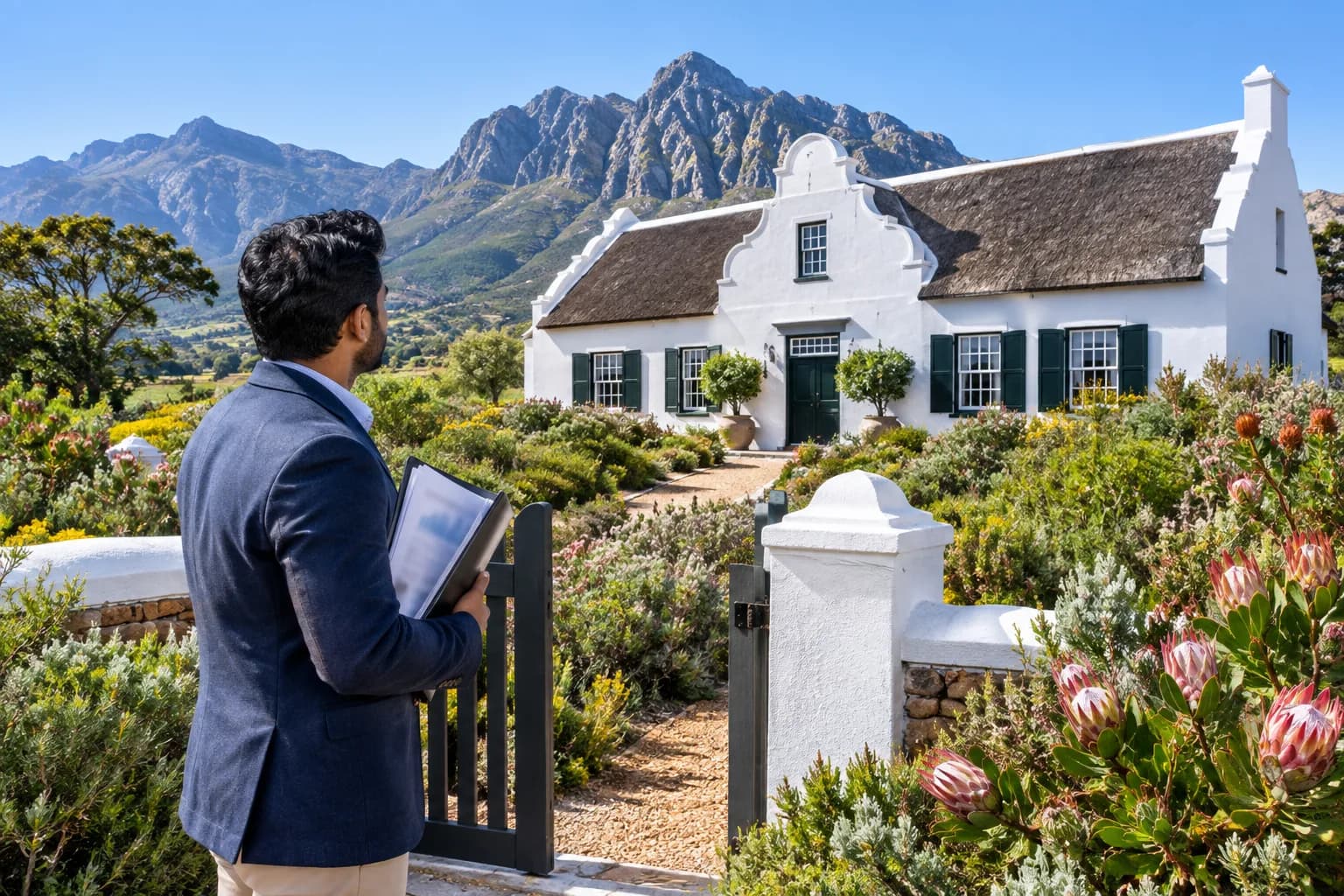
The framework here is broader than most foreign buyers expect. A non-resident, a foreign national living in South Africa on a work or study permit, a foreigner living abroad with no South African visa, and a foreign corporate entity can all hold registered title to South African property. There is no minimum investment threshold for residential property, and the land audit data the government has published shows foreign nationals already own land in all nine provinces. The one group that can't buy is foreigners living in South Africa illegally: conveyancers won't register property for anyone without lawful status here. The practical constraint for most buyers isn't the right to buy. It is managing the money correctly across the border and understanding the tax that follows.
Permanent residents occupy a middle ground. They live in South Africa, their funds are already in the country, and the exchange control rules apply to them differently. A permanent resident buying with local income and savings navigates a simpler path than a non-resident wiring funds from abroad. Both buyers end up at the Deeds Office. The route to get there differs, and so does what happens when each one eventually sells.
How exchange controls affect your purchase
Every rand entering South Africa to buy property passes through the exchange control system administered by the SARB. This isn't an obstacle. It is a record-keeping mechanism protecting the buyer's right to get that money back out when the property is eventually sold. The SARB's institutional sector classification framework separates residents from non-residents, and for exchange control the same question, resident or not, decides which rules apply to you.
The practical requirement is this: funds from abroad must enter through a South African bank in a formal, documented transfer. The bank issues a deal receipt confirming the foreign currency that came in and the rand amount it bought. Keep that document. The conveyancer also arranges for the title deed to be endorsed "non-resident". When you eventually sell and want to send the proceeds back to your home country, your bank uses the deal receipt and that endorsement to process the transfer out. Without them, repatriation becomes a slower, more complicated process. The pen on a property purchase contract is the easy moment. The deal receipt is the document worth safeguarding from that same day.
Financing options for non-resident buyers
South African banks do grant home loans to foreign buyers, but the terms differ from those offered to citizens and permanent residents. Most banks set a lower loan-to-value ratio for non-residents, often 50% of the purchase price, which means a non-resident buyer needs to bring a larger cash deposit than a local buyer would. The deposit must enter the country through the same exchange control process described above, documented and declared through a registered bank.
The bond application follows the same steps as any local application through the conveyancing process: credit checks, affordability assessments, employment verification. The difference is that foreign income is assessed in rand at the current exchange rate, and that rate is the bank's rate at the time of assessment, not the buyer's preferred one. Bond approval takes time regardless of nationality, and non-resident applications usually take longer than local ones, so allow extra time. Pushing the bank before the documentation is complete rarely shortens the timeline.
What taxes apply to foreign property owners?

South Africa taxes property ownership and property sales the same way for local and foreign buyers, with one structural difference: withholding tax applies when a non-resident sells. Transfer duty, a tax paid to SARS when a property is purchased, applies to all buyers. It is calculated on a sliding scale based on the purchase price, and the current brackets are published on the SARS transfer duty page. There is no separate exemption for first-time buyers: purchases below the first bracket on the scale pay no transfer duty, for local and foreign buyers alike.
When a foreign owner sells, capital gains tax applies to the profit on the sale, and if the price is more than R2 million the buyer is legally required to withhold a percentage of the price and pay it to SARS (in practice the conveyancer handles this) before the balance goes to the seller. This withholding, known as the Section 35A withholding, exists because SARS can't easily collect from a non-resident after the money has left the country. The withholding isn't a final tax. The seller submits a South African tax return and receives a refund if the withheld amount exceeds the actual liability. The property law framework governing these obligations sits within the broader landscape covering the Deeds Registries Act, the Income Tax Act, and the Transfer Duty Act.
Listed property investment for foreign buyers
Foreign buyers have a second path into South African property without buying a specific house or flat: listed property through Real Estate Investment Trusts, known as REITs. A REIT is a company listed on the Johannesburg Stock Exchange (JSE) owning and managing income-producing property. National Treasury has noted that the South African REIT framework should align with internationally recognised REIT standards to promote foreign investment in the listed real estate market. For a foreign investor wanting exposure to South African property without the complexity of direct ownership, a JSE-listed REIT offers a regulated, liquid alternative.
Direct ownership and listed investment carry different risk profiles and different tax treatments. A foreign individual buying shares in a REIT doesn't pay transfer duty. The income received is taxed as dividends under South African dividend tax rules, and exchange controls still apply to the movement of investment funds in and out of the country. The SAPOA industry body tracks commercial and listed property performance across South Africa and publishes sector data international investors use to assess market conditions. Neither route, direct or listed, removes the obligation to comply with South African tax law.
The registration process and what to expect

Once the offer to purchase is signed and the exchange control documentation is in place, the conveyancing and registration process follows the same path as any local sale. A conveyancer appointed by the seller handles the transfer. The Deeds Office processes the registration. Title transfers into the foreign buyer's name. The timeline from signed offer to registered title tends to run eight to twelve weeks, depending on bond approval, municipal rates clearance, and Deeds Office queues at the time.
A non-resident buyer doesn't need to be physically present in South Africa for registration. The conveyancer can work with a power of attorney, allowing a representative in South Africa to sign documents on the buyer's behalf. That power of attorney must be signed in the buyer's country of residence, notarised, and apostilled or legalised depending on whether the country is a signatory to the Hague Convention. Commissioning it early in the process, rather than at the moment the conveyancer needs it, keeps the Deeds Office queue from becoming the constraint.
Closing Reflection
You started with a question: whether the rules would let you buy at all. The answer is yes, with conditions. The conditions are manageable: documented funds, a registered bank, a conveyancer who has handled this before, and a tax return when you eventually sell. The exchange control rules exist to protect your money as much as to track it. The deal receipt kept from the day of purchase is the document getting your proceeds home when the time comes. The process isn't complicated. It is unfamiliar, and working through it once is enough to make it plain.
You shouldn't have to piece together South African property law from a dozen different sources before deciding whether to buy. With Golden Homes you won't.
Contact Golden Homes to speak with an agent who understands what foreign buyers need before they sign anything.
Foreign property ownership raises specific questions without obvious answers. Here are the ones that come up most often.
Frequently Asked Questions
Can foreigners buy property in South Africa?
Yes. South Africa doesn't restrict foreign nationals from buying residential or commercial property. There is no citizenship requirement and no minimum investment amount for direct residential purchases. A foreign buyer registers title at the Deeds Office in their own name, the same as a South African citizen. The one condition is that a buyer living in South Africa must be here legally. The legal right to own property isn't the constraint most buyers face. What requires planning is the exchange control process: funds from abroad must enter through a registered South African bank, and that inward transfer must be formally documented to secure the buyer's right to repatriate the proceeds later. A non-resident buying with foreign-sourced funds should arrange the banking infrastructure, including the deal receipt from their South African bank, before the offer to purchase is signed. A conveyancer experienced in non-resident transactions is worth appointing early, because they can confirm what documentation the bank and the Deeds Office will require for the specific buyer's circumstances. Permanent residents already living and earning in South Africa face a simplified version of the same framework, because their funds are already inside the country's financial system.
Are taxes higher for foreign buyers of South African property?
The transfer duty rate is the same for foreign and local buyers. It is calculated on the purchase price using the sliding scale SARS publishes, and it applies to every buyer regardless of nationality. Where foreign buyers face a different tax treatment is at the point of sale. When a non-resident sells South African property, the buyer is required under Section 35A of the Income Tax Act to withhold a portion of the price if it is more than R2 million, and the conveyancer usually handles this before the balance is paid out. This withholding applies specifically to non-residents and exists because SARS can't easily collect from someone who has already transferred funds abroad. The withheld amount isn't a final tax. The seller submits a South African tax return and receives a refund if the actual capital gains tax liability is lower than the withheld amount. Foreign buyers should also note that rental income earned from South African property is taxable in South Africa, regardless of whether the owner is resident here. A South African tax practitioner registered with the South African Revenue Service is the appropriate adviser for your specific tax position.
Do foreign buyers need a company or trust structure to buy South African property?
No. A foreign individual can buy South African property in their own name without any corporate or trust structure. The Deeds Office registers natural persons and legal entities equally. Some buyers choose a company or trust for estate planning reasons, for tax structuring, or because the property is an investment rather than a primary residence. A South African company or trust owning property is a local entity for tax and exchange control purposes, which changes how income and proceeds are treated on the way out of the country. A foreign corporate entity owning South African property is classified as a non-resident for SARB purposes, and the same exchange control documentation requirements apply. The choice of ownership structure affects estate duty, capital gains tax, and the complexity of winding up the structure when the property is eventually sold or inherited. None of these structures are required for a straightforward residential purchase. They are worth considering in conversation with a South African tax attorney or conveyancer, not as a default assumption. The structure suiting a buy-to-let investor differs from the one suiting a buyer purchasing a family home.
Disclaimer: Everything on this blog is written to inform and educate. It is for information only. Nothing here is professional legal, financial, or technical advice. If you are making a significant business decision, speak to a qualified professional first. Golden Homes works hard to keep this content accurate and current, but is not liable for decisions made based on what you read here.