
Ask Golden Homes

You're at the kitchen table with the Offer to Purchase in front of you, pen in hand, and one small field stops you cold. Single, married in community, married out of it, and you are no longer sure which line is yours. You wonder whether your husband needs to sign too, and you reach for the antenuptial contract you signed years ago, not quite sure where it went. The estate agent wants the form back by Friday.
What the marital status declaration covers
Marital status in an Offer to Purchase is the legally required declaration of your matrimonial regime, whether you are single, married in community of property, married out of community of property (with or without accrual), divorced, or widowed. This declaration determines who must sign the OTP, whose consent is required for the transaction, and how the property will be registered at the Deeds Office. An incorrect or incomplete declaration produces document errors that the Deeds Office won't accept.
Getting it right at signing avoids the most common delay in this part of the sale: a document that must be corrected and signed again.
Key Takeaways
- If you're married in community of property, you can't sign an OTP alone, both spouses must sign because the joint estate means both are parties to every major financial transaction.
- If you're married out of community of property, you may sign alone but must still declare the marital regime, the Deeds Office needs this information to register the property correctly.
- If you're divorced, you must provide the divorce decree, if the property was part of the divorce settlement, the decree must confirm that you have sole authority over it.
- If you're widowed, you must provide a death certificate and may need to provide the marriage certificate, these documents confirm the chain of ownership and your legal authority as the surviving spouse.
- Foreign marriages are governed by the law of the country in which they were concluded, the conveyancer must verify the foreign marital regime before the OTP can proceed, which may require sworn translations and apostilled documents.
Why marital status counts in a property sale

In property, marital status isn't a personal detail. It's a legal condition that determines financial power and contractual authority. When you sign an Offer to Purchase, your marital status tells the conveyancer who owns what, who must consent, and how the property must be recorded in the Deeds Office.
A single incorrect declaration can result in:
- Delays in lodging transfer
- Rejected documents from the Deeds Office
- Missing signatures that invalidate the contract
- Banks refusing to grant a bond until proper consent is provided
The law requires transparency so that no spouse is disadvantaged and no property is transferred without proper authority. It protects both parties from disputes and ensures that every transfer is built on truth.
In practice, the declaration tells the conveyancer whose signature and consent are needed, how the title deed will describe the owner and whether a spouse's estate is affected. A wrong answer can mean the transfer or bond documents have to be redrawn and signed again, which costs time. Check your marriage certificate and any antenuptial contract before you complete this part of the offer.
Marriage in community of property: joint ownership, joint consent
Most South Africans marry in community of property. It's a marital regime where two people become one legal estate. Everything is shared, and every asset or liability belongs equally to both spouses.
In property transactions, this means:
- Both spouses must sign the Offer to Purchase
- Both must consent to selling or buying
- Both names must appear in the transfer documents
- Neither spouse may act on the property without the other
Even if one spouse is the only one paying the bond or living in the home, the law recognises the shared ownership created by marriage. Without both signatures, the contract can't move forward.
Conveyancers are strict about this requirement. If one signature is missing, the sale is frozen until the spouse signs. Transparency protects the marriage and the transaction.
If one spouse is away or unable to sign, the other spouse can usually give written consent, signed before two witnesses, instead of signing the offer. Ask the conveyancer early which form they need, because a missing consent is one of the most common reasons a transfer stalls at this stage.
Marriage out of community of property: independence with rules
Where you've signed an antenuptial contract, you're married out of community of property. Each spouse holds their own estate, their own assets, and their own responsibilities. You may buy or sell property without involving your spouse, unless your contract states otherwise.
Yet the marital regime must still be declared in the Offer to Purchase. This is needed for two reasons:
- The Deeds Office must know which contract governs the marriage.
- Banks and conveyancers must register the property correctly.
You may sign alone, but the legal record must reflect the marriage to ensure that future transactions remain transparent and compliant.
The conveyancer will ask for a copy of the antenuptial contract, or at least its registration details, to confirm the regime. If the contract was never registered at the Deeds Office, the marriage may be treated as in community of property as far as third parties are concerned, which changes who must sign. Check this before the offer is signed, because fixing an unregistered contract after the event needs a court application. Keep a copy of the registered contract with your important documents, so it is ready whenever you buy or sell property.
Marriages with the accrual system
Some antenuptial contracts include the accrual system. It doesn't affect the signing of the Offer to Purchase, but it affects how assets are divided if the marriage ends.
For property transactions, this means:
- The spouse signing acts alone.
- The property will belong solely to the signing spouse unless otherwise stated.
- The accrual system is noted for future reference but doesn't restrict the sale or purchase.
Although accrual concerns the division of assets, the Offer to Purchase must still reflect the marital regime accurately to keep the legal record correct.
Under the accrual system, each spouse keeps their own estate during the marriage, and the growth in both estates is shared when the marriage ends by divorce or death. A spouse married with accrual can usually buy or sell property in their own name without the other's consent. The Offer to Purchase and the title deed still record the marital status, so give the agent and conveyancer your antenuptial contract details at the start. If the property was owned before the marriage, the starting value of that estate, recorded in the contract, may affect how the accrual is worked out later.
Antenuptial contracts without accrual: complete financial separation
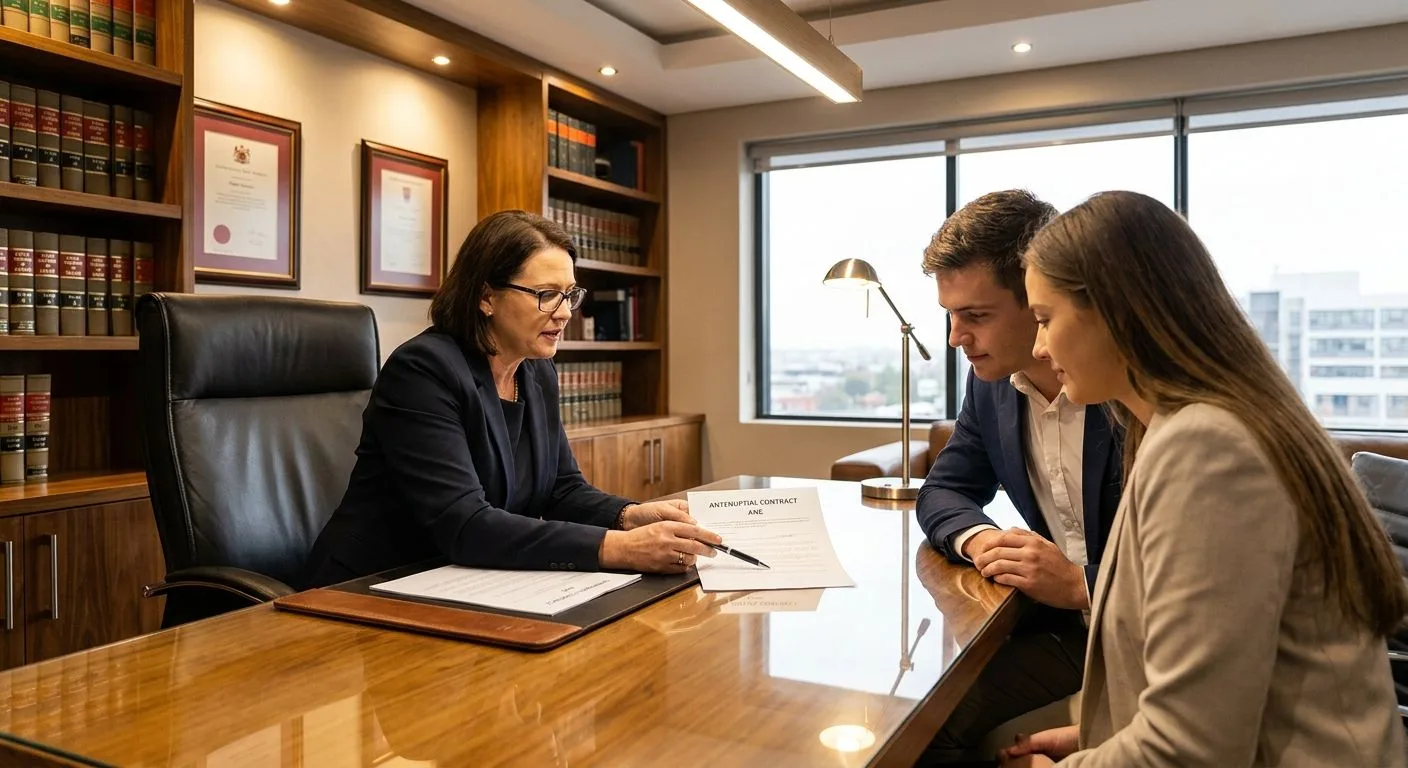
Some couples choose an antenuptial contract without the accrual system, creating a marriage where each spouse's estate remains entirely separate. In this regime, assets never merge and financial responsibility rests with each individual alone. For property transactions, this creates one of the simplest signing processes because only the spouse involved in the purchase or sale needs to appear on the Offer to Purchase. The other spouse has no legal claim to the property and no consent is required.
Even though you sign alone, the marital regime must still be declared correctly. The Deeds Office needs this information to record the ownership structure and prevent future disputes. An antenuptial contract without accrual is a system built on independence, and the Offer to Purchase must reflect that independence with complete accuracy.
Under complete separation, each spouse owns and controls their own property, and neither shares in the other's growth when the marriage ends. Buying or selling in one spouse's name needs only that spouse's signature, but the agreement must still describe the marital regime accurately, with the contract registration details.
Ask your agent to confirm this before you sign.
Foreign marriages: additional documentation required
If you were married outside South Africa, the marital regime is governed by the laws of that country. The conveyancer must verify how that foreign marriage handles property ownership and consent.
This may require:
- A marriage certificate
- A sworn translation
- A declaration of the foreign marital regime
- Legal opinions or apostilled documents in complex cases
Without this information, the conveyancer can't determine who must consent. The Deeds Office won't register property until the marital regime is confirmed.
Foreign marriages are common, but they require early preparation to avoid transfer delays.
Where spouses married outside South Africa, the law of the country where the husband was domiciled at the time of the marriage usually decides the marital regime, and that may differ from where the couple now live. The conveyancer may ask for the marriage certificate, a copy of any marriage contract, and sometimes a legal opinion on the foreign law. Translated documents may need to be certified. These steps take time, so tell the agent at the start if either spouse married abroad, and gather the documents before the offer is signed.
Divorced or widowed buyers and sellers
Even after a marriage ends, the legal consequences remain relevant in property transactions.
A divorced seller should provide a copy of the divorce order and any settlement agreement, because they show who owns the property after the divorce. If the property was in a joint estate, it may need to be endorsed or transferred into one spouse's name before it can be sold. A widowed seller whose late spouse was a co-owner must deal with the property through the deceased estate, with the executor's authority. Tell the agent about these details at the start, so the conveyancer can plan the correct route.
If divorced:
The Offer to Purchase may require:
- A copy of the divorce decree
- Proof that the property forms part of the signing spouse's estate
- Confirmation that no consent is required from the former spouse
If the property was awarded to one spouse in the divorce, that must be clearly stated in the decree.
If widowed:
The conveyancer may request:
- A death certificate
- A copy of the marriage certificate
- Confirmation that the surviving spouse is the rightful owner
These documents protect the transaction and ensure that the chain of ownership remains unbroken.
Why accuracy holds the process together
Marital status is more than a formality. It determines authority, ownership, and consent. If the declaration is incorrect, the sale can't proceed. Together with proof of identity and residence, it forms part of the core parties and documents section of your OTP.
Conveyancers check this detail right at the start because every document from SARS to the Deeds Office depends on it. The truth makes the process strong. Accuracy is the foundation on which registration is built.
In practice, the marital status appears in several documents: the Offer to Purchase, the power of attorney to transfer, the bond documents and the new title deed. Each must match. A mistake in one can lead to a rejection at the Deeds Office, and the documents must then be corrected and signed again. To avoid that, give the agent your full names exactly as they appear on your identity document, your marriage certificate and any antenuptial contract before the offer is drafted. Read the parties section carefully before you sign, and ask the agent to correct anything that is wrong. Small corrections at the start save weeks later.
Before you sign: your marital status checklist

- Declare your marital status exactly as it appears in law
- Provide your marriage certificate or antenuptial contract if applicable
- Ensure both spouses sign when required
- Submit divorce or death certificates when relevant
- Confirm all details before the Offer to Purchase is finalised
A few minutes of honesty and preparation prevent delays that can stretch for weeks.
In practice, start with the marriage. If you are married in community of property, your spouse must consent in writing to the purchase or sale of the home, and both of you are usually named on the title deed. If you are married out of community of property with an antenuptial contract, you can usually buy or sell alone, but the conveyancer will still need a copy of the contract to confirm it was registered. If you were married outside South Africa, the law of the country where the husband lived at the time of the marriage may decide your marital regime, so tell the conveyancer early. Divorced or widowed buyers and sellers need the divorce order or death certificate, and sometimes the letters of executorship. Getting these documents together before you sign the offer saves the conveyancer from chasing them later.
Closing Reflection
Marital status can look like a small box on an Offer to Purchase, but it decides who signs, whose consent is needed and how the property is registered. Check your marriage certificate and any antenuptial contract before you sign, declare your status exactly, and tell the agent early if you married abroad, divorced or lost a spouse. With the right details from the start, the conveyancer can prepare the documents once, and the transfer moves to registration without avoidable delays.
You shouldn't have to declare marital status on an Offer to Purchase without understanding which regime applies, what documents are required, and what happens if the declaration doesn't match what the Deeds Office finds. With Golden Homes you won't.
Contact Golden Homes before signing any offer, an agent will confirm which marital regime applies, what documentation the conveyancer needs, and whether both spouses are required to sign before the document is presented.
The topic often raises specific questions. Here are the ones agents hear most from buyers and sellers across South Africa.
Frequently asked questions
Why must I declare my marital status when signing an Offer to Purchase?
Marital status determines who has legal authority to sign the OTP, whose consent is required for the transaction, and how the property must be registered at the Deeds Office. South African property law protects both spouses in a marriage by ensuring that no major asset can be sold or acquired without the correct authority. Someone married in community of property cannot act without their spouse because the joint estate means both are parties to every major financial transaction. Someone married out of community of property may act independently, but the marital regime must still be declared because the Deeds Office needs it to register the property correctly. An incorrect or missing declaration produces errors across multiple institutions. SARS, the Deeds Office, and the bank, that must be corrected before transfer can proceed. Declaring the correct marital status upfront is the declaration that allows every subsequent document in the chain to be prepared accurately.
What happens if I state the wrong marital status on the Offer to Purchase?
An incorrect marital status declaration produces document errors that the Deeds Office, SARS, and the bank cannot process without correction. If a spouse who should have signed did not, the Deeds Office will reject the lodgement. If the declared marital regime does not match the records at Home Affairs, additional affidavits must be drafted, signed, and lodged before the error can be resolved. These corrections typically add several weeks to the transfer timeline. In cases where one spouse was unaware of the transaction or where the incorrect declaration changes how the property should have been registered, disputes may arise that require legal intervention rather than a simple addendum. The correction process is straightforward when caught early, before the OTP is signed, and expensive when caught late, after lodgement has been attempted and rejected. Providing the marriage certificate, antenuptial contract, or divorce decree to the conveyancer before signing prevents the discrepancy from entering the document chain.
Does my spouse need to sign if we are married out of community of property?
A buyer or seller married out of community of property without the accrual system may sign the OTP independently because each spouse's estate is entirely separate. The other spouse has no legal claim to the property and no consent is required. However, the marital regime must still be declared accurately on the OTP, the Deeds Office needs this information to register the property correctly and the conveyancer needs it to comply with legal drafting requirements. Where the antenuptial contract includes the accrual system, the rules are the same during the transaction: the signing spouse acts independently, because the accrual only applies at dissolution of the marriage. Banks often request marital information as part of the bond application credit assessment, and failing to disclose it can slow bond approval even where no consent is legally required. Declaring the regime correctly ensures all institutions in the transfer chain work from the same accurate record.
What documents are required when a seller is divorced or widowed?
A divorced seller must provide the divorce decree before the OTP can proceed. The conveyancer needs the decree to confirm that the property forms part of the signing spouse's estate, that no consent is required from the former spouse, and that the chain of ownership is unambiguous. If the property was awarded jointly to both spouses in the divorce settlement, both signatures are required to sell, which means the seller must locate and obtain the former spouse's signature before transfer can proceed. A widowed seller must provide the death certificate of the deceased spouse and may need to provide the marriage certificate. These documents confirm that the surviving spouse is the rightful owner and that no other party has a claim to the property. In both cases, the documents should be submitted to the conveyancer before the OTP is signed, not after, gaps in the ownership chain discovered during the transfer process cause far more delay than gaps identified before signing.
Disclaimer: This blog is provided for general information only and does not constitute advice. For advice specific to your circumstances, please contact your closest Golden Homes.